Saturday, October 20, 2012

Genealogy and Politics

George Merriman in 1899
As a matter of self-preservation and diplomacy, I avoid contributing to any discussion about politics.  I am presenting the issue here though to highlight genealogy research being used for an unusual purpose.

Recently, one of my cousins sent me a link she came across regarding my great-great-grandfather, George Merriman of Medford, Oregon.  At first glance, the page seemed typical and unremarkable; it contained a short biography from an 1896 publication and a basic chart showing his descendants.   Further browsing though revealed that this information was essentially published for propaganda purposes for a political party.

The page in question is on a blog titled Oregon Republican League, which describes itself as "dedicated to building a Republican majority in the state of Oregon, through directed issues research/review, outreach and social service projects."  The included biography of my great-great-grandfather was actually from a Republican publication which described George's involvement with the Republican party in the 1880s and 1890s.  The information about my ancestor was published in 2006 as part of a "Bridging the Generations Project", along with hundreds of other posts including biographies and genealogies of Oregon Republican politicians from the 1890s. 

The implicit purpose of the project was to inspire current generations of Oregonians to associate with the Republican party because their ancestors happened to be relatively prominent Republican politicians.  This is a seemingly creative and innovative method of attempting to gain supporters and members of a particular political party.  Admittedly, the blog post is 6 years old and the "project" seems to have been effectively abandoned, with no activity on the blog for at least 2 years.  Also, it is not clear how, if at all, the blog and its efforts were related to or endorsed by the official Oregon Republican Party.  Research at the Oregon Secretary of State reveals that the Oregon Republican League was officially incorporated in 2004, but has since become inactive.

Aside from whether this effort had any connection to the official Republican Party, it makes me wonder whether the use of genealogy research would actually be effective in gaining support for any political purpose.  A major flaw in the logic is that political party platforms and ideologies change over time, and the Republican Party of the 1890s is not quite what it is today.  (Another great-great-grandparent of mine from the same time period, Josephine Plymale, was a staunch Republican who also happened to be quite progressive and something of a militant feminist.) Additionally, although a person might find it interesting that a particular ancestor happened to be a politician, would that do anything to actually sway their own political ideologies?  As a genealogist, I personally resent my family tree being perverted and used by any political party for their own purposes.  At least the blog project did not include the names or identitities of living individuals. 

My great-great-grandfather George Merriman was a founding settler of the city of Medford, Oregon.  He was a lifelong blacksmith who owned his own business for many years and raised a family of 7 children.  George was definitely a staunch Republican, and although he rarely held political office, he was involved with the party in many ways.  He was a member of at least five Republican conventions in the 1880s and 1890s; he was elected as trustee for the city of Oakland, Oregon; he served on the city council of Medford, Oregon; and was involved with a number of other related committees and clubs.  In 1892, he ran for the position of Jackson County Sheriff, but was defeated by a small majority.  In 1895, he was almost appointed as the warden for the Oregon State Penitentiary.  Between 1900 and 1904, he served as Postmaster for the city of Medford.  His personal passion and interest was in educational matters, serving on the school board of Medford and was also a founder and director of the city's first college, Medford Business College.  Aside from a passion for education, we do not know much about George's specific political ideologies.  Perhaps a clue to his ideologies is a strangely-worded statement from a 1912 biography: "He has sought not alone his good but also that of the public."  Also, from a 1904 biography: "While not seeking recognition himself he has earnestly helped his deserving friends, and by no means confined himself to any one party in offering help."

Sunday, August 5, 2012

Children

What follows is a variety of photos of children in family tree, ranging in dates from the 1860s to the 1980s. 

Two of my great-great-grandfather George Merriman's sisters: Lucinda
Merriman (left) and Mollie Merriman (right), circa 1867, Jacksonville, Oregon.
Courtesy Southern Oregon Historical Society

My great-great-grandfather Oscar Wadleigh at about 5 years old, circa 1870.  He is
sporting what was apparently fashionable dress for little boys.  Sanbornton, New Hampshire.

Mary J. Halliburton, the niece of my great-great-great-grandmother
Elizabeth Halliburton Current.  Photo taken in about 1875 in
Clarksville, Tennessee. Mary died from yellow fever in 1878 at the
age of 9 along with all of her siblings.
Photo from Barbara Wentz via findagrave.com
Three of my great-grandmother Vera Merriman's siblings: Thomas Merriman
(left), George Merriman (middle) and May Merriman (right).
Photo taken circa 1888, Medford, Oregon.
Two of my great-grandfather Benjamin Plymale's sisters: Marie Plymale (left)
and Emaline Plymale (right), circa 1893, Jacksonville, Oregon.
Courtesy Southern Oregon Historical Society.
 
My great-grandfather Neil Bixby, circa 1898, Garden City, Minnesota.

Three children of Fred Wadleigh, my great-great-grandfather's brother: Theodore
Wadleigh (left), Ruth Wadleigh (center), Winthrop Wadleigh
(right), circa 1906, Milford, New Hampshire.
My great-grandfather's niece Arline Bixby, circa 1918, Minnesota.
Courtesy Debra McEachern.
My grandfather's brother Eric Wadleigh (right) and his cousin
Harry Dragoo (left), circa 1922, Indianapolis, Indiana.
Left to right: Keith Bixby (my grandmother's cousin), Evelyn Bixby (my grandmother's sister),
Shirley Bixby (my grandmother's sister), Deane Bixby (my grandmother's brother),
circa 1928, Portland, Oregon.
My grandmother Bettye Brown, circa 1930, unknown location.
My grandfather Paul Wadleigh, circa 1933, Indianapolis, Indiana.
My grandmother Patricia Bixby (bottom right) and her siblings (Evelyn, Shirley and Deane, in back) and cousins
(Keith and Dennis Bixby, front), circa 1933, Portland, Oregon.
My mom's birthday in 1956, Seattle, Washington. Left to right: George Plymale, Margaret Brown,
Tracy Brown, Barbara Plymale, Catherine Plymale.
My dad and his siblings and cousins at their grandparents' house for Christmas, apparently making a gingerbread house,
late 1950's, Indianapolis, Indiana. 
My cousins Deana Plymale and Ira Wilks, 1981, Woodinville, Washington.

Sunday, June 17, 2012

an inventor in the family

The actual design figures for Hugh's sawing machine,
from Patent #136,216
(courtesy US Patent Office)
My great-great-great-grandfather Hugh Current was born in 1832 in central North Carolina and came from a relatively poor family. Sometime between 1850 and 1857, Hugh moved by himself out west and settled in Clarksville, Tennessee.  There he married Elizabeth Halliburton in 1859, the eldest daughter of a wealthy plantation owner.

Hugh was sometimes a farmer, but it seems that his primary vocation and skills were in woodworking.  In 1860 he was described as a carpenter.  In 1873 or 1874, Hugh moved with his family from their rural farm to a house in the city of Clarksville.  There, Hugh opened up a chair making business where he devoted himself to making quality hand-made chairs for his customers.  His speciality was rocking chairs.  Hugh owned and operated his chair making business in Clarksville for at least seven years, and probably longer.  At some point after his chair making enterprise, Hugh also owned and operated a printing supply business.  In old age, after having outlived two of his wives and separating from his third, Hugh became a minister in the Universalist church.  Current Street in Clarksville was named after him and his family.

Prior to opening his chair making business, Hugh put his innovative mind to use and decide to invent something.  The date and origin of the actual invention is unknown.  Eventually though, Hugh created designs and specifications for his invention and submitted it to the US Patent Office.  His patent (#136,216) was then issued on February 25, 1873 and is permanently on file with the Patent Office.  Hugh's invention is titled "Improvement in Sawing-Machines."   The machine is a free-standing apparatus with conveyor belts and circular saws.  The anticipated use of the machine was to take large "cord-wood" and cut it quickly and neatly into three pieces that would be the appropriate size for wood or cook stoves.  The entire patent can be viewed online.
Hugh Current and his second wife Margaret,
in about 1880.
(courtesy Jim Long)

Although the patent was issued, the Patent Office has no record that the machine was ever produced.  We must assume though that Hugh at least produced a prototype machine and probably others for friends and customers in Clarksville.  Interestingly, Hugh's 1873 patent was cited in the research of a 1990 "cherry splitter" patent, which employed a similar overall design to split cherries.

The invention of a firewood sawing machine perhaps seems a little odd.  I cannot help but draw a comparison to Disney's Beauty and the Beast, in which Belle's father's invention is also a machine to chop firewood (although the design is completely different).  The invention story did not appear in any of the original stories and was an element added by Disney.  Was Hugh viewed as odd by his children and contemporaries just like Maurice?

My descent from Hugh:
Hugh A. Current md. Elizabeth G. Halliburton
- Georgia Current md. Christopher C. Brown
-- Newell B. Brown md. Louetha Jones
--- Bettye B. Brown md. Paul C. Wadleigh
---- Randy Wadleigh md. Barbara Plymale
----- Ryan Wadleigh
newspaper advertisement for Hugh's
chair making business
(from Sep. 25, 1875 edition of the
Clarksville Weekly Chronicle)


Monday, May 28, 2012

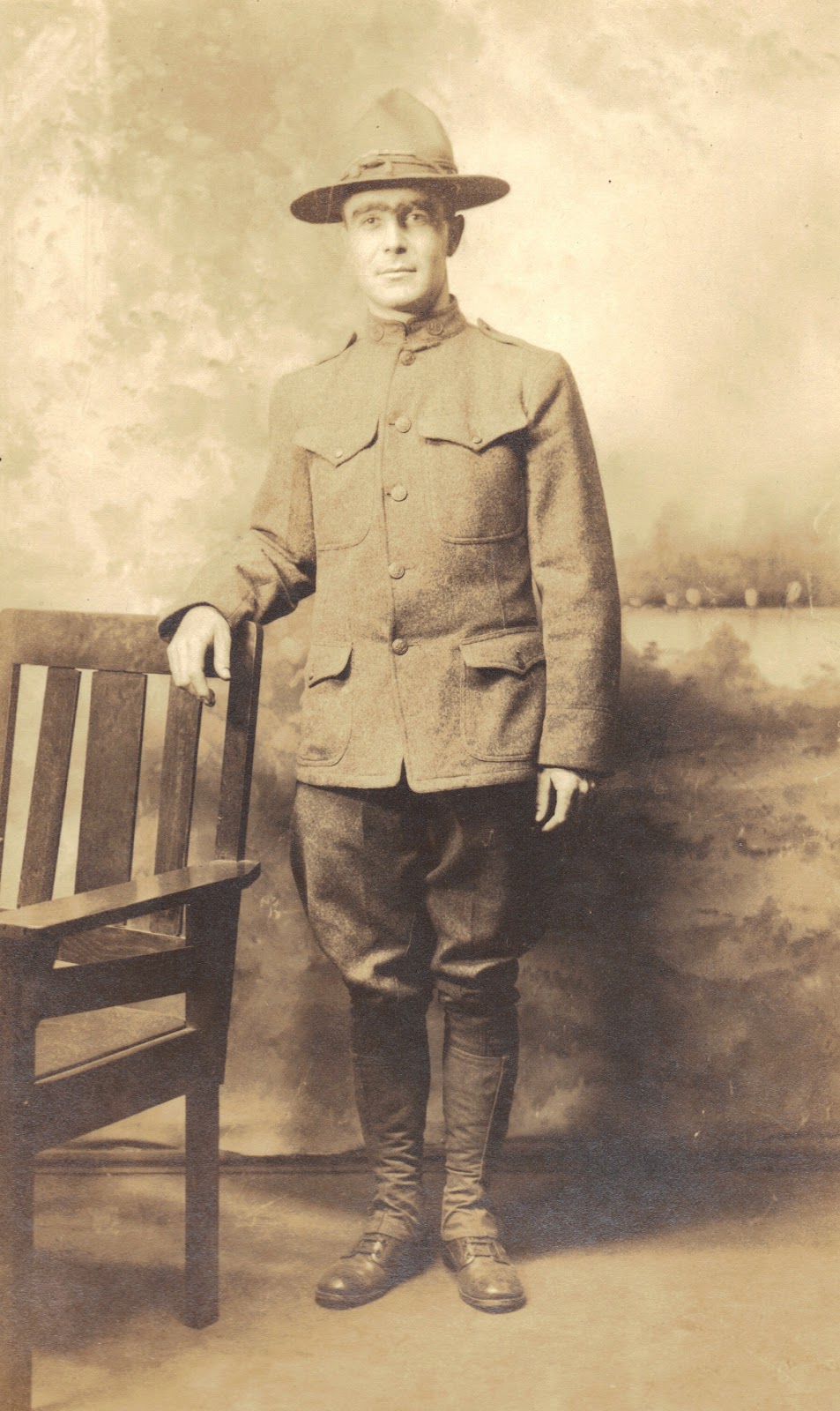
military glamour shots

On this Memorial Day holiday, I am honoring my ancestors and their siblings that had military service.  Following is photographs of them:
World War II
My paternal grandfather Paul C. Wadleigh (1925-2007)
Paul served in the Navy during WWII as a mine sweeper in the Pacific Theater. 
He later served in the Korean War before being discharged in 1954 as a lieutenant.
My grandfather's oldest brother Eric J. Wadleigh (1916-2011)
Eric was a member of the 72nd Field Artillery Regiment of the Army during World
War II. 

My grandfather's middle brother Gerald M. Wadleigh (1920-1984)
Gerald was a lieutenant in the Army Signal Corps during World War II, serving in
Germany and England.  He was discharged in 1946. 
My maternal grandfather Ben T. Plymale (1926-1981)
Ben was in the ROTC during high school and then served in the Navy between 1944
and 1946.  During his service, he was based primarily on Guam.
My maternal grandmother's only brother Deane F. Bixby (1921-1944)
Deane was a lieutenant in an engineer battalion of the Army between 1942 and 1944,
serving in Europe on two separate deployments.  At the end of his second deployment
he was in charge of mine-sweeping and road clearing so that tanks could proceed.
  Somewhere in Germany in December 1944 he was personally inspecting a road in spite
of machine-gun fire when he was killed by an enemy bullet.  His heroism apparently
saved the lives of his men behind him and allowed them to capture 28 German soldiers.
  He was awarded a posthumous Bronze Star.

World War I
My great-grandfather's brother Gerald T. Wadleigh (1893-1983)
Gerald served in the Navy during World War I.
 
My great-grandfather Benjamin H. Plymale (1888-1929)
Benjamin served as a Mess Sergeant in the Army during World War I between
1917 and 1919. He served in Europe, with the majority of time spent in France. 

 
My great-grandfather Neil F. Bixby (1893-1985)
Neil served in the Army during World War I from 1917 to 1919, being
stationed in Europe. He later worked as a civilian for the Army
Corps of Engineers for over 30 years.


Civil War

My great-great-great-grandfather Irvin H. Thurston (1828-1887)
Irvin was a physician by profession, so he served in the Union Army between 1862 and 1865,
first as an assistant surgeon and then as a full surgeon in the 8th Minnesota Infantry.
  With his regiment, he served in Minnesota, Tennessee and North Carolina.

Monday, May 21, 2012

Manslaughter!

Proper genealogical research aims at uncovering the truth about our ancestors, however unsavory that truth may be.  One such example of moral failings was in 1655 when my distant ancestors Robert and Susannah Latham were responsible for the death of their 14-year old servant.

In 1655, Robert and Susannah Latham were a young couple living in the town of Plymouth in Plymouth Colony, in what is now Massachusetts.  They had been married for about six years and had about four or five young children. Both Robert and Susannah came from Puritan families that were among the original settlers of the Plymouth Colony. Susannah's mother, Mary Chilton, was a passenger on the Mayflower, and said to be the first white woman to set foot on Plymouth Rock.

Robert and Susannah were not wealthy, but by the winter of 1654-1655 they did have a servant named John Walker.  John Walker was at the time about 14 years old and was perhaps an indentured servant.  On January 15, 1654/1655, John Walker died while in the custody of his "master", Robert Latham.  His body was subsequently brought before a coroner's jury.  The inspection found that John's body was covered with bruises, slashes and open sores and showed evidence of being frozen.  When questioned, Robert admitted to whipping the boy, including the day he died.  A witness also testified that at one time John was made to carry a log that was much heavier than him and when it fell on top of him, he was whipped by his master until he got up. The investigation revealed that John was also not given sufficient food, clothing or lodgings.  John was "put forth in the extremity of cold", and thus died.  The inference then is that poor John literally froze to death, his death being exacerbated by starvation, mistreatment and physical injuries.

Upon these findings, Robert Latham was arrested and was indicted for "fellonious cruelty."  At the next meeting of the court, Robert was found guilty of "manslaughter by chaunc medley." ("chance-medley" was an old legal term used to describe unintentional killing, but usually in terms of self defense) During the proceedings, Robert asked for mercy in his punishment. He was sentenced to be "burned in the hand" and all of his goods were to be confiscated by the court.  This was a rather light sentence given that the punishment for murder was execution.  The wording of his guilty verdict though implied that the jury did not believe that Robert intended for John to die, thus he was not deserving of the full punishment for murder.

Although Robert was convicted and sentenced for John's death, it became clear that his wife Susannah was also indirectly responsible for John's death.  The inference is that although Susannah might not have physically harmed John, both Robert and Susannah had colluded with each other about the treatment, and that Susannah did nothing to help him.  On June 6, 1655, Susannah was brought before the court and arraigned for cruelty.  She was never prosecuted for the crime and eventually the matter was dropped entirely in 1658, leaving her a free woman.

Robert and Susannah's oldest daughter Mercy Latham was my ancestor.  During the murder and subsequent trial of her father, Mercy was just 4-years old.  It must have been made on a strange impression on young Mercy to possibly be witness to a murder and to have known that her own parents were responsible for the death of an innocent person.

My descent from Robert and Susannah:

Robert Latham md. Susannah Winslow
- Mercy Latham md. Isaac Harris
--- Desire Harris md. John Kingman
---- Deliverance Kingman md. Ebenezer Orcutt
----- Samuel Orcutt md. Susanna Bates
------ Keziah Orcutt md. Jesse Worrick
------- Hannah Worrick md. Thaddeus Bixby
-------- Henry A. Bixby md. Mary Palfrey
--------- Henry W. Bixby md. Julia M. Thurston
---------- Neil F. Bixby md. Bertha Hoffman
----------- Patricia J. Bixby md. Ben T. Plymale
------------ Barbara Plymale md. Randy Wadleigh
------------- Ryan Wadleigh

Sources:
1. Records of the Colony of New Plymouth in New England. Court Orders. Vol. III. 1651-1661. Boston, William White Printer, 1855.
2. Walker, J.B.R. Memorial of the Walkers of the Old Plymouth Colony.  Northampton, Metcalfe & Co., 1861.
3. Savage, James. A Genealogical Dictionary of the First Settlers of New England. Boston, Little, Brown & Co., 1860.
4. Stratton, Eugene A. Plymouth Colony. Its History & People. 1620-1691. Salt Lake City, 1986.

Wednesday, May 9, 2012

The Queen's American Ancestors

Augustine Warner Jr.  The original portrait was
apparently destroyed in a fire. This is probably
the copy of the portrait that was made and is now
held by the George Washington Foundation
Queen Elizabeth II of the United Kingdom has a family tree that is filled with the royalty and nobility of Europe.  It might surprising then to learn that the Queen actually has American ancestors.  Ironically enough, these same American forebears are also shared by George Washington, the old nemesis of the British.  My family also descends from these same common ancestors of Queen Elizabeth II and George Washington.

The most recent common ancestors of Queen Elizabeth, George Washington and myself were Augustine Warner Jr and his wife Mildred Reade of colonial Virginia.  Both Augustine and Mildred were born in the early 1640s in Virginia.  Their parents had migrated to Virginia from England (although Mildred's mother was at least half French).  Mildred Reade also has proven direct descent from King Edward III of England through her paternal grandmother.  Mildred's great-uncle Sir Francis Windebank was Secretary of State under King Charles II. 

Augustine Warner was born in 1642 or 1643 in Virginia.  In 1658, at about the age of 16, he was sent to England where he was educated at the Merchant Taylors' School in London.  After finishing his education, he returned to Virginia where he married Mildred Reade, the daughter of a prominent Virginian landowner.  They lived together on a Virginian estate given to them by Mildred's father until 1674 when Augustine inherited his family's estate - Warner Hall - from his father.  The land containing Warner Hall had originally been granted to Augustine's father in 1642 and the plantation house was built sometime after this date.  The estate is located in Gloucester County, Virginia on the Severn River, off of Chesapeake Bay.

Augustine was prominent in Virginia politics during his adulthood.  He served in the House of Burgesses from 1666 to 1677 and was its Speaker on two separate occasions.  He later served on the Governor's Council from 1677 to 1681.  Augustine was also closely involved with Bacon's Rebellion of 1676-1677, being a supporter of Governor Berkeley.  During the crisis, the rebels managed to seize Warner Hall, damaging the house in the process.

After the death of Augustine Warner in 1681, his widow Mildred and their children continued to live at Warner Hall.  Apparently, after Augustine's death Mildred was left with custody of a large amount of arms and ammunition (perhaps left behind during Bacon's Rebellion) and she refused to give them up until they were taken from her by force. The couple had three known sons, but all three died without producing children.  The surviving heirs of Augustine and Mildred Warner were thus their three daughters: Elizabeth Warner Lewis (my ancestor), Mildred Warner Washington Gale (George Washington's ancestor) and Mary Warner Smith (Queen Elizabeth's ancestor).

Elizabeth Warner married John Lewis and inherited Warner Hall from her brother George in about 1702 and lived there until her death in 1720.  She was my direct ancestor.  Another of her direct descendants was Meriwether Lewis, of Lewis and Clark fame.

A current photo of Warner Hall in Gloucester County,
Virginia, from the Inn at Warner Hall's website
Mildred Warner was married first to Lawrence Washington and second to George Gale.  In 1700, she moved with her second husband to England, where she died soon after.  Mildred is the grandmother of George Washington.

Mary Warner married John Smith and settled in Gloucester County, Virginia.  Their daughter Mildred Smith married Robert Porteus and moved to England in 1720.  Their descendants later intermarried with the English gentry and nobility.  Eventually, their descendant Elizabeth Bowes-Lyon married George VI of England, making them ancestors of Queen Elizabeth. 

Warner Hall stayed in the family for about 200 years, being passed down to descendants of Elizabeth Warner Lewis.  Eventually, the plantation was sold to an unrelated family in the 1830s.  Unfortunately, the estate suffered at least two devastating fires that destroyed the original 17th Century home.  The owners then rebuilt a colonial-style mansion on the original foundation, and it is still standing to this day.  Warner Hall is currently a bed & breakfast (Inn at Warner Hall) and is on the National Register of Historic Places.  Although the actual house dates from the 19th Century, there are numerous outbuildings and the family cemetery which survive from earlier times.

In 1957, Queen Elizabeth II made a trip to the United States and Virginia to commemorate the 350th anniversary of the founding of Jamestown.  During he trip, she visited Warner Hall and placed a wreath on the grave of her ancestor Augustine Warner.  During the trip she was also given a gift of a copy of a portrait of Augustine Warner.  In England, Warner Hall is apparently known as the "home of the Queen's American ancestors." During her 1957 trip, Elizabeth was quoted in a speech saying: "Yes, I am proud of my American ancestry and of the part they played in the war that we fought against us."

My relationship to Meriwether Lewis, George Washington and Queen Elizabeth II:


Sources:

1. Tyler, Lyon G. Encyclopedia of Virginia Biography, Volume I. Lewis Historical Publishing Co., New York, 1915.
2. Sorley, Merrow E. Lewis of Warner Hall, The History of a Family. self published, 1935.
3. McAllister, John M. and Tandy, Lura B. Genealogies of the Lewis and Kindred Families. E. W. Stephens Publishing Co., Columbia, Missouri, 1906.
4. Bolitho, Hector. "The Queen's American Ancestors", unknown date. Retrieved from http://www.bigballoonmusic.com/goddardreagan/TheQueensAmericanAncestors.htm
5. "Augustine Warner, Jr.", in Wikipedia: The Free Encyclopedia, retrieved from http://en.wikipedia.org/wiki/Augustine_Warner,_Jr.
6. "Just a little bit of history" at Inn at Warner Hall, retrieved from http://www.warnerhall.com/bed-and-breakfast-virginia-history.asp
7. Tombstone inscriptions, Warner Hall Cemetery, Warner Hall, Gloucester Co., Virginia
8. Hudgins, William H. "The Queen Visits Soil of Her American Ancestors", Richmond Times-Dispatch, October 17, 1957

Sunday, April 1, 2012

a thief in the family

the portion of the letter William Kirlin wrote in 1851
describing the theft by Vashti Dunham
In 1851 my great-great-great-great-grandmother Vashti Willits Dunham was living in Centerville, Indiana.  She was 42-years old and was married with a family of seven children. Vashti was the daughter of Levi Willits and Rachel Field, both from Quaker families. Vashti was born in Ohio but as a child moved to Indiana with her family.  In 1828, her father Levi Willits died and her mother later remarried to William Kirlin.

Vashti's mother Rachel Field Willits Kirlin died on March 10, 1851 at the age of 71.  She left a surviving husband, William Kirlin, and many grown children and grandchildren.  As part of the distribution of her effects, it was decided that all of Rachel's clothing and personal items would be divided equally between her three daughters (Mary, Sarah and Vashti) and her three daughters-in-law (Polly, Sarah J., and Sarah A.).

At the time, only four of the women - including Vashti - lived nearby.  They met at their stepfather's house and divided the clothing equally in six ways.  Each of them took their share home and left two piles for the women who lived out of state.  My ancestor Vashti then devised a plan to get her hands on more of the clothing.  She found out that a neighbor was coincidentally about to travel to where her brother James and his wife Sarah were living in Illinois.  She went back to her stepfather's house and told him that if he gave her one of the piles of clothing, she would then give it to the neighbor so that it could get safely to her sister-in-law in Illinois. William agreed to the plan and gave Vashti the clothing intended for his step daughter-in-law. 

Then, while the clothing was in her custody,Vashti stole some items before giving them to her neighbor.  Apparently one of the things she had stolen was an expensive shawl that William Kirklin had given as a gift to his wife Rachel.  Apparently, he had paid $10.00 for it (or about $280.00 in today's money). 

William Kirlin found out about the theft and then wrote a letter on May 3, 1851 to his stepson James Willits explaining what had happened and that he knew Vashti was a thief.  He then included an inventory of what he knew had been in the pile (a gold watch, a plaid dress, another dress, a silk apron, a white cape, gloves and other items that he did not remember), so if there was anything else missing, he knew who to blame.  William then asked James if he wanted him to confront Vashti about it or just let it go.  It is unknown what eventually happened with the issue.  Interestingly though, when James and Sarah's first daughter was born in 1854, they named her Vashti after the sister who had apparently stolen from them. 

Vashti and her family did not remain in the area for long. A few years after the incident, she and her family moved out west to Iowa.  She later lived in Kansas and Missouri.  Despite her apparent theft and possible strife with her stepfather and siblings, she appears to have been very close to her children.  All of her children survived to have children of their own. Sadly, during the 1860s four of her adult children suffered from untimely deaths leaving a large network of parentless grandchildren.  We have three letters that Vashti wrote in 1870-1871 to her son-in-law Irvin Thurston in Minnesota after the death of her daughter Lydia from consumption (tuberculosis).  In these letters she expressed much sympathy to Irvin and his four young daughters (including my great-great-grandmother Julia, then 5 years old).  She expressed interest in doing what she could from afar (she sent the girls each a pair of stockings that she had made) and also gave Irvin her blessing to remarry so that the family would not have to be separated. 

Sometime during the 1860s, her elderly-husband John Dunham moved by himself to New Mexico to be a silver miner.  She never saw him again.  They both died during the early 1870s. 

My decent from Vashti:

Rachel Field md. 1st. Levi Willits md. 2nd. William Kirlin
- Vashti Willits md. John Dunham
-- Lydia Dunham md. Irvin Thurston
--- Julia Thurston md. Henry Bixby
---- Neil Bixby md. Bertha Hoffman
----- Patricia Bixby md. Ben Plymale
------ Barbara Plymale md. Randy Wadleigh
------- Ryan Wadleigh