Sunday, March 22, 2015

Women's History Month

March is Women's History Month - a fitting time to honor the women in my family tree. When I started researching my family tree, I did not know anything about the lives or accomplishments of my ancestors. Researching these real people has been fulfilling to me as I’ve learned about the fascinating lives of those who have come before me. They were a part of history, and also helped to shape who I am today.

This post focuses on just a few of the women in my family tree who had remarkable aspects of their lives.  But, all women in my family tree deserve to be honored. All of these women were daughters, were wives, were mothers; they all lost something; they all persevered and they all lived. They all deserve a 'high five'.  Unfortunately, even in my own family tree the lives of my female ancestors are overshadowed by their male counterparts.  For many of my female ancestors, I don't know much about them except their names and who they happened to be related to.

Today, all women should be honored and attention should be paid to continued gender inequality around the world. But I also want to draw attention to some of the struggles and strength of women throughout history and within my own family tree.

Josephine Martin (1845-1899)
Josephine Martin, c. 1870s


My great-great-grandmother Josephine Martin was a fascinating woman and accomplished more in her short life than most people do in their lifetime. First and foremost, she was a wife and mother of 12 children. She was also a very active Women's Suffrage activist. Additionally, she was a Temperance activist; she was politically active and ran for political office; she worked as a committee clerk for the state legislature with her daughters; she was a school teacher; she worked as a buggy driver; she was a newspaper journalist; she was a popular speech giver; she was a farmer. She had much energy and strength of character to accomplish so many things, while also raising her large family. She was not meek or subservient and in her time went against her father, her husband, her pastor and her community; but still maintained respect and dignity. In her lifetime, she was described as "sharper than lightning". 

In addition to her accomplishments, she also went through tragedy. One of her children died as a baby during an epidemic. In 1888, her house burned down in the middle of the night and the whole family escaped unharmed, but lost all of their possessions. Her contemporaries remarked that she had maintained a cheery disposition throughout the rest of her life until her death at the age of 54 - "she was always ready with a pleasant or witty expression under the most irritating circumstances".  Much more about her life is in an earlier post - Pioneer Feminist.

Artinecia Riddle (1830-1917)
Artinecia Riddle, c. 1880


My great-great-great-grandmother Artinecia Riddle was a courageous woman and a sturdy pioneer. She was married young but was widowed at the age of 20. In 1851, she left behind everything she knew and crossed the Oregon Trail as a 20-year old widow with her infant son. During her crossing on the Trail, she performed a surgical operation on a man that had been shot because there was no one in the train with any surgical or medical skill. She settled in the frontier of southern Oregon and soon remarried and had 15 more children. As opposed to other white settlers, Artinecia and her family became friendly and close to the local Native Americans and they were also fluent in the Chinook dialect that they spoke. In 1855, war broke out between the whites and the local Indians. Artinecia was hired by the government to work as an interpreter between the military and the local tribes. She fulfilled this role with bravery while living in a military camp between 1855 and 1856.

She continued living in southern Oregon and thrived as a farmer, while raising her 16 children. Her second husband died in 1877, and the 47-year old widow continued to run the family farm and raise her children on her own. During the 1870s, she was also documented as being a supporter and activist (a "staunch coworker") of the Women's Suffrage movement.

In old age (in about 1914), she was filmed and appeared in a silent movie made to promote the Rogue River Valley of southern Oregon, where she lived. Her movie was presented at the Pan-Pacific Exposition in San Francisco in 1915.

Abigail Tilton (1842-1929)
Abigail Tilton, 1858


My great-great-great-grandmother Abigail Tilton was the daughter of a Baptist minister and was one of the oldest children in a very large family. When she was 15, her mother died in childbirth. Until her father remarried two years later, Abigail was the oldest woman in the household and was instrumental in caring for her 9 younger siblings. Although her family did not have much money, her father wanted all of his children to have excellent educations. After her public school education was over, Abigail attended two different seminary schools. She then worked for about 4 years as a school teacher.

She was married at the age of 22 and then focused on raising her family. One of her children, Helen, had a mental illness and Abigail devoted herself to caring for her daughter for the remainder of her life, until she died at the age of 86.

Patricia Bixby (1928-2008)

Patricia Bixby, 1946
My grandmother Patricia Bixby was a strong woman and a great source of inspiration to me. After high school, she worked as a secretary. She married my grandfather at the age of 20 and continued working for 2 years to support her husband while he was in graduate school. She then quit her job to raise her children and devoted her time on her family. Sadly, after nearly 20 years of marriage she discovered that her husband had been unfaithful to her and was having an affair with another woman. 

After an emotionally tumultuous time, she made the difficult decision to divorce her husband and start her life anew. After the divorce was finalized in 1968, she took a course and went back to work as a secretary. She continued working and supporting herself until she retired at 60.

Patricia had her share of tragedy and sadness in her life. Two of her children died as babies and two more children died as relatively young adults. Her only brother died when she was 16, all of her other siblings predeceased her, and she lost her marriage through adultery. In spite of what she went through, she was one of the most positive people I have ever known and continued to have an infectious smile and inner joy that radiated to those around her. Even on her death bed she was continuing to smile at those around her. Her simple strength has been a major source of inspiration to me in my life.

Maxamillia Bouseman (1808-1868)
Maxamillia Bouseman, c. 1850


My great-great-great-great-grandmother Maxamillia Bouseman was born in Ohio and later lived in Illinois. She married young and had ten children. Then in 1851, she and her family left their life behind and moved over the Oregon Trail. In Oregon, they lived in a frontier environment. She and her family became quite friendly with the local Native Americans that lived near them. She and her family also became well versed in the language that they spoke. The tribe also had their own names for her and her family. Maxamillia was called "Mulagolan" (which meant “mother”).

Sadly, the harmony in the area did not last as conflicts arose between the Indians and other white settlers. By 1855, it had culminated into war. In late 1855, after the war had just begun, Maxamillia left by herself on horseback to visit the tribal encampment and plead with them to not go to war. Many of the other settlers asked her not to go, fearing for her safety. But she insisted that she would not be harmed and she went anyway. Later, after the war was in full swing, some soldiers arrived at her home and told her she would probably not be safe at home. She lost patience and responded to them: “You gentlemen seem to forget that those two boys back there are lying dead through your incompetence, and as to leaving my home again, all I ask of you is to leave my boys with me, and we will take care of ourselves.” She then remained with her children in their home in spite of the wartime concerns. 

Baefje Pieters (c. 1620-1680s)

Baefje Peters was from Amsterdam, Netherlands and migrated to New Amsterdam (now New York City), when she was young.  She was married in 1641 and raised a family of at least two children.  They later moved to Beverwijck (now Albany), New York.  During her marriage, Baefje was apparently the primary breadwinner for her family.  She owned and operated a tavern in Beverwijck, while her husband had no occupation. 

Baefje's first husband died and she remarried during the 1670s.  Sadly, her second husband was apparently abusive and a drunk.  Fortunately, in 1679 she took it upon herself to leave the situation and separated from her husband.  Three years later, he repented and agreed in court to not mistreat her anymore and would avoid drunkenness in the future. 

Rachel Field (1780-1851)

My ancestor Rachel Field was born in 1780 in Pennsylvania.  She was raised as a Quaker.  Rachel married Levi Willits in 1797, when she was 17.  At the time, she was disowned from her faith for marrying Levi, who was not a Quaker.  I do not know anything about her marriage.  But I can only speculate that because she risked being disowned she had married for love (or at least by her own choice), as opposed to many of her contemporaries. 

Rachel had 9 children.  She and her family later lived in Ohio and Indiana.  Her husband died in 1827 and she remarried to William Kirlin, who survived her.  Rachel died in 1851 at the age of 71.

Marye Du Trieux (1617-c. 1670s)

My ancestor Marye Du Trieux was a pioneer of New York City and was also one of this nation's first female business owners.  As a child, in about 1624, She moved to New Amsterdam (now New York City) from Amsterdam.  Marye married twice and had 8 children.  She was first acknowledged as owning and operating a tavern in 1644.  She continued operating her tavern for at least 20 more years and also worked as a trader.

More about her life is in an earlier post - banishment and an illegitimate child

Marie Bradley (1881-1973)

Although not a direct ancestor, Marie Bradley had a fascinating life.  Marie was the first cousin of my great-grandmother Vera Merriman.  She was a child labor activist.

Marie was raised in southern Oregon but decided that she wanted to pursue a higher education.  She eventually attained her bachelors and masters degrees.  She put herself through college by teaching school. Then she quickly turned her attention to investigation and activism in the child labor issue.  In 1907, she moved to Washington, DC and was hired by the US Bureau of Labor, where she worked as a special agent to investigate working conditions for children and women.  During most of that time she investigated the glass industry, where children aged 6-10 often worked 10-12 hour days. 

Marie later married a fellow child labor investigator and remained active in labor causes for most of her adulthood. 

Martha Woodson (1795-1859)

My great-great-great-great-grandmother Martha Woodson was born in 1795 in Virginia.  She married her first husband, Anthony Jones, in 1809 when she was only 13 years old and he was 28.  They had 4 children were together and were married until he died in 1824, leaving her a 28-year old widow.  Martha remained unmarried for 7 years, continuing to raise her children. 

Then in 1831, Martha remarried.  She was 35 years old and her new husband, Archibald Fletcher, was 19 years old - 16 years her junior.  In fact, Martha's new husband was the same age as her oldest son Albert Jones.  I assume that this arrangement must have been a little odd and maybe even scandalous.  But I also hope that marrying a much younger man was a result of her own independence and her own choice in a husband.

Sarah Crenshaw (c. 1761-1846)

My great-great-great-great-great-grandmother Sarah Crenshaw was born in about 1761 in Virginia.  She was married to John Wallace in 1780 when she was 19.  Surviving records suggest that her marriage caused something of a scandal and was not approved of by her father.  Although we don't know why, we can assume that her marriage was her own choice and hopefully because of love. 

I don't know much about the life of Sarah.  She had 11 children and remained married to John Wallace for 65 years.  Their youngest daughter Harriet Wallace suffered from a disease that made her crippled from the age of 5.  Apparently she was crippled in her feet, legs, hands and arms and was not capable of walking or standing.  Still, Sarah continued to raise and nurture their daughter.  In 1821, Sarah wrote a letter in which she tenderly described an illness that Harriet was suffering from and how she tried to coordinate Harriet being able to travel to visit relatives.  Harriet was at that time 23 years old, and it is the last reference to her being alive.  She probably died not long after.

In about 1835, when Sarah was in her 70s, their house burned to the ground and the family managed to escape unharmed, but they lost all of their belongings.

Sarah Dearborn (1778-1864)

My ancestor Sarah Dearborn spent all of her life in New Hampshire.  She married at 21 and had 12 children.  In her life, Sarah displayed independence from her husband by having different religious views and attending a different church.  Her husband, Josiah Tilton, was a member of the Baptist Christian denomination.  Sarah, on the other hand, was a member of the Congregational denomination.  They disagreed on account of minor differences between the denominations, and attended different churches.  Sarah's independence made an impression on her children.  Her son remarked that while her husband Josiah was "sometimes disagreeable", Sarah was "amiable and easy tempered".  Her son also noted that she was an accomplished singer with a "powerful voice and high pitch".  He also described her as "a woman of great executive ability, physical force, clear, strong mind and naturally high tempered yet pleasant". 

Lydia Dunham (1836-1869)
My great-great-great-grandmother Lydia Dunham was born and raised in Indiana, but moved to Iowa with her family as a teenager.  She was married on her 19th birthday to Irvin Thurston, a doctor.  They moved to Minnesota, where she remained for the rest of her life.  She had 5 daughters.

Unfortunately, I don't know much about Lydia.  In 1862, her husband enlisted as a surgeon in the Civil War.  Until he was discharged three years later in 1865, she remained behind in Minnesota to manage their farm and raise their daughters.  She was reunited with her husband, but continued to experience loss.  In 1867, their 8-year old daughter Cora died from an illness - which must have been tragic for the family.  Sadly, in spite of being married to a doctor, Lydia suffered from consumption (tuberculosis) and she died in 1869, at the age of 33 - her daughters were then 12, 10, 5 and 1.  Afterward, the family was in a difficult situation and Irvin feared that he would have to split up the family and send his daughters to various relatives, because he could not care for them by himself.  Fortunately, Lydia's elderly mother Vashti Dunham sent Irvin a letter giving him her blessing to remarry so that the family could remain intact.  Irvin eventually did remarry and was able to keep his family together.

Although I don't know much about Lydia's personality or life, I do know that she must have been an accomplished horseback rider.  In 1865, she won the award for Best Lady Equestrianship at the county fair. 

Christina "Dora" Lilienthal (1834-1921)

My great-great-great-grandmother Christina Lilienthal was born in northern Germany.  As a young woman, she left her family and moved by herself to Denmark where she married and began raising a family.  Although they were relatively comfortable in Denmark, the situation became uncertain for her family when Prussia gained control of the area and began drafting all available men into the army.  In 1871, her husband Christian Kling suddenly fled to America to avoid being conscripted into the Prussian army.

Christina must have been in a difficult situation, having been abandoned by her husband.  She had 5 young children aged between infancy and 10 years.  She spent the next year in Denmark, but eventually decided to follow her husband to America.  In 1872, they left their home forever and went by ship to England.  They made their way to Liverpool, England and boarded a ship named "City of New York", bound for the US.  They arrived in New York City in October 1872.  It must have been difficult for her to have made this journey with only her 5 young children, with no knowledge of the languages or the customs of the countries that they passed through. 

Eventually, Christina reunited with her husband.  They then moved out west to Iowa and then Minnesota, where they remained.  When Christina and her children made the trip over the Atlantic Ocean in 1872, they were the last of my ancestors to have moved to America from their homelands.

Susan Sthreshley (1774-1846)

Susan Sthreshley was not my direct ancestor, but she was the sister of my ancestor William Sthreshley.  Susan spent her life in Virginia and Kentucky.  She married Daniel Preston in her youth. They had no children; although she helped to raise her orphaned niece.  Susan and her husband were wealthy, and owned slaves.

Susan's husband predeceased her and she continued managing her home in Hopkinsville, Kentucky.  Susan wrote her will in 1844 and died in 1846.  Susan's will was interesting because she left none of her estate or property to her family or relatives.  Instead, she left all of her property to her slaves and to her church.  She also directed that her slaves be freed and allowed to move to Liberia, Africa if they desired.  Although she unfortunately did not free her slaves during her lifetime, Susan's directions in her will reflect a strength and independence of character to do exactly as she wished. 

Sunday, May 11, 2014

Mother's Day

Enjoy this short collection of photos of mother's in my family tree with their children.

Happy Mother's Day!

My great-great-great-grandmother Artinecia Riddle Merriman with 10 of her 16 children, circa 1890, Medford, Oregon.
Left to right: Auletta Merriman Harvey, Lucinda Merriman Prather, Will Merriman, George Merriman (my great-great
grandfather, Effie Merriman Hill, Artinecia Riddle Merriman, Isabel Merriman Fronk, Isaac Merriman, Josephine
Merriman Beek, Marie Merriman Bennett, Laura Merriman Bradley


My great-great-grandmother Julia Thurston Bixby with her son Neil,
my great-grandfather, circa 1917, Salem, Oregon


My great-great-grandmother Mary Murray Merriman with three of her daughters:
l to r: Blanche, Mollie and Vera (my great-grandmother). Circa 1918, Medford, Oregon


My great-grandmother Louetha Jones Brown and my grandmother Bettye, circa 1926, Helena, Arkansas
My great-grandmother Louetha Jones Brown and my grandmother Bettye, circa 1938, Indianapolis, Indiana

My great-grandmother Louise Custer Wadleigh and my
grandfather Paul, c. 1940, Indianapolis, Indiana


My great-great-grandmother Christina Kling Hoffman and her four children:
l to r: Ernest, Bertha (my great-grandmother), Dora and Howard, circa 1940,
Mankato, Minnesota
 
My great-grandmother Bertha Hoffman Bixby and my grandmother
Patricia
, circa 1940, Mankato, Minnesota

My grandmother Bettye Brown Wadleigh and her children, l to r: Mark, Randy, Karen, 1952, Indianapolis, Indiana


My grandmother Patricia Bixby Plymale and my uncle George,
1953, Seattle, Washington


My grandmother Patricia Bixby Plymale and her four children: Catherine, Deane, Barbara, George
circa 1963, Port Angeles, Washington


My grandmother Bettye Brown Wadleigh (Staley) and my Dad, 1964

My grandmother Bettye Brown Wadleigh, her eldest child, Karen, and eldest grandchild, Lisa 1969

My grandmother Patricia Bixby Plymale and my mother Barbara, 1967


My mom and I, circa 1985, Federal Way, Washington
My mom and my sister Carmen, 1995, Kent, Washington


My mom and three of her kids, 2012,
Boston, Massachusetts

Wednesday, April 2, 2014

The Oregon Trail

1907 map showing the main route of the Oregon Trail
As a child, I was fascinated by historical stories of explorers, adventurers and pioneers.  In particular, the Oregon Trail was a topic that I was especially obsessed with.  I have fond memories of playing the Oregon Trail video game as well as other Oregon Trail games and activities in school.

At the time, I had no idea that many of my ancestors had actually traveled on the Oregon Trail and had their own stories about their long journeys into the wilderness.  Specifically, 13 of direct ancestors traveled on the Oregon Trail in five different crossings between 1843 and 1852.  In total, at least 57 family members made the trip in the same 5 trips.  (All of these people were ancestors and relatives of my maternal grandfather Ben Plymale.) 

This blog post explores these Oregon Trail journeys and the stories that have survived about them.

Deaths

The majority of my family safely traveled the Oregon Trail and arrived to their destinations with little or no incident.  There were a few family members though who died during or as a result of their journeys:
  • In about April 1852, my great-great-great-grandfather's first wife, Mary Lewis Merriman, died of an unknown illness somewhere in what is now Kansas - and was buried by the trail's side. 
  • In about August 1852, my great-great-great-grandfather's infant son Joseph W. Merriman died in northern California after drinking cow milk that was contaminated by poisonous wild parsnips. He went into convulsions and died within hours.  He was buried by the trail's side. 
  • In October 1852, my great-great-great-great-grandfather Gabriel Plymale and his son Anderville Plymale both contracted typhoid fever after drinking contaminated water at Goose Lake in northern California.  They died within two months of arriving in Oregon. 
Injuries
  • Sometime in late summer 1851, while the train was somewhere in Nevada, my great-great-great-great-grandparents' 6-year old son John B. Riddle fell from a moving wagon and was run over by the front wheel but was pulled to safety before being run over by the rear wheel.  He was briefly unconscious, but made a full recovery. 
Other 

  • In 1851, the wagon train that the Riddle family was traveling in was attacked by Indians and one of the men in the train was shot in the arm.  My great-great-great-grandmother Artinecia Riddle Chapman performed a minor surgical operation by removing bone fragments from the wound. 
  • From 1843-1844, my great-great-great-grandfather William J. Martin went on an expedition to Oregon and California with the explorer John Fremont.  The reports created during the trip were said to be responsible for the Mormons choosing Utah as a place of settlement.
Artifacts
  • There are two quilts from the Riddle family that they brought with them over the Oregon Trail in 1851.  There is also a "ginger jar" brought by the Plymale family in 1852.  These items are held by the Southern Oregon Historical Society in Medford, Oregon.
 Diaries/Stories
  • Brief Review of the Life of Isaac Constant -  Transcription of an interview (c. 1890s) with Lavinia Constant Robinson who was 18 years old when she crossed the Oregon Trail in 1852 (Lavinia was the niece of my great-great-great-grandfather William Merriman)
  • Early Days in Oregon - Series of articles written by George W. Riddle in 1920, recounting his family's journey on the Oregon Trail in 1851 and subsequent pioneer life (George was the brother of my great-great-great-grandmother Artinecia Merriman)
  • The Unknown - Article written by William J. Plymale (date unknown) regarding an 1852 Oregon Trail journey (William Plymale was my great-great-grandfather)

1843 - Martin
My great-great-great-grandfather William Martin
of Missouri.  He went on an expedition to
Oregon and California in 1843.  He later moved to Oregon
with his family in 1846.
(courtesy Douglas County Museum)
In 1843, my great-great-great-grandfather William J. Martin was 28-years old and lived in western Missouri. He was married and had one young daughter.  He had worked as a farmer, tavern keeper and ferry boat operator and was also a wounded war veteran.  We can assume that he was restless with a drive for adventure.  For unknown reasons, he decided to leave his family and go on an exploratory expedition to the west coast.  It must have been especially difficult for his young wife Harriet, who was left alone with their child and the very real possibility that he might never return.

The spring that year was very late and so the departure of the train was delayed. The party finally left Missouri on May 22, 1843.  The train traveled west until June 8, 1843, when the captain - Peter Burnett - resigned.  William Martin was then elected captain in his place.  At that time, the wagon train split in two.  William Martin continued as captain of the smaller group - with 72 wagons and 175 men.  During his tenure as captain, William apparently had trouble controlling many of the younger men in the group.  (It was probably because of these problems that William declined serving as captain when he made the same trip 3 years later).

When the train reached the Rocky Mountains (probably in what is now Wyoming), William was remembered for killing an animal that was described as a "rare carnivorous animal, much like a hyena" (probably a wolverine).  Somewhere in Idaho, William joined with a group of men traveling to California.  At this point, it is not clear what route or schedule they took to get there - but they probably traveled through Idaho, eastern Oregon and northern California.  Eventually, William arrived at Sutter's Fort, California (in modern Sacramento) in early 1844.  William spent 6 weeks at Sutter's Fort.  Then in March 1844, William joined with the explorer John Fremont in an expedition back east.  (The city of Fremont, California and Seattle's Fremont neighborhood are both named after this explorer).  

The Fremont expedition left Sacramento in March 1844 and traveled south through the San Joaquin Valley of California.  At about what is now Bakersfield, California they turned east into Nevada and went through what is now Las Vegas.  From there, they traveled north through Utah and met up with the traditional Oregon Trail in Wyoming.  They then traveled east through Wyoming, Nebraska and Kansas.  They arrived back home in Missouri in August 1844 and William rejoined his family.  Some of the reports created on this expedition were said to be responsible for the Mormons choosing Utah as a place of settlement. 

References:

Bakken, Lavola J. "William Jennings Martin." The Umpqua Trapper, 13(4). Douglas County Historical Society, Roseburg, OR, 1977.
 
Obituary of William Martin, The Plaindealer, Roseburg, OR, Apr. 29, 1901
1846 - Martin
Letter written by William Martin in 1846 advising other emigrants
on how to prepare for the Oregon Trail. 
Transcribed and published in Overland in 1846, Volume 2.
After visiting Oregon and California in 1843-1844, William J. Martin quickly realized that he wanted to move out west permanently.  In addition to deciding to move with his wife and children; he was able to convince many of his relatives to move as well.  In 1845, his brother and sister migrated over the Oregon Trail with their families.  The other members of the family (including William) decided to wait an additional year.  

William and his family were busy preparing for the move between 1845 and 1846.  In January 1846, William wrote a letter - which was published in the St. Joseph Gazette newspaper - advising other emigrants on how to prepare for the journey.  During the last months before departure, many of William's friends tried to convince him to be Captain of the wagon train.  He declined the offer though, because it entailed "much responsibility and little honor."  Although William initially declined serving as captain, he unofficially traveled in a leadership capacity and was called captain anyway.  His family's wagons were often in the lead of the wagon train.  

The Martin family that traveled in 1846 included about 17 members: William Martin (31), his wife Harriet Martin (29); their daughters Catherine (4), Frances (10 months) and Josephine (my great-great-grandmother - 10 months); his mother-in-law Catherine Crobarger (68); his parents Zadock Martin (57) and Susannah Martin (about 58); his brother Frank Martin (34) and sister-in-law Lucretia Martin (18).  The family also probably traveled with William's paternal cousin Franklin Martin (22) as well as his maternal cousin Milton Brown (31) and Milton's wife Christina Brown and their four children: Mary, Susan, James and Frances Brown. 

The family left their homes near Platte City, Missouri (near what is now Kansas City) in early April 1846.  We do not know much about this particular wagon train's crossing - it must have been relatively uneventful.  They apparently traveled north from their homes and left from St. Joseph, Missouri on about April 10, 1846.  Their wagon train was quite large, with over 100 wagons and 600 people.  Over the duration of the crossing - the train split off into different groups at least two times.  From St. Joseph, they traveled west through what is now Kansas, Nebraska, Wyoming, Idaho, and finally into Oregon.  They were at Fort Laramie, Wyoming on June 10, 1846.  On June 23, 1846, an observer came across the Martin wagon train when it was crossing the North Platte River, in central Wyoming, and made the following observation: "we had the pleasant sight of beholding the valy (sic) to a greate (sic) distance dotted with peopl (sic) horses cattle wagons and tents their being 30 wagons all buisily (sic) engaged in the crossing the river which was found to not be fordable with the poor material they had to make rafts of it took two trips to carry over one wagon with its lading." Another observer mentioned finding the Martin train at Red Butte, Wyoming and that they were "travelling (sic) on cheerily, having met with few impediments to their journey."

The train arrived in northern Oregon on September 15, 1846 and the family quickly moved to Yamhill County, Oregon (southwest of what is now Portland), where William's brother Hardin had settled the year before.  Eventually, the family dispersed and moved elsewhere.  My ancestor William Martin moved with his family to southern Oregon; where they remained.

References:

Morgan, Dale. Overland In 1846: Diaries and Letters of the California-Oregon Trail. Volume 1. Talisman Press, Georgetown, CA, 1963.

Morgan, Dale. Overland In 1846: Diaries and Letters of the California-Oregon Trail. Volume 2. Talisman Press, Georgetown, CA, 1963.

Genealogical Material in Oregon Donation Land Claims, Volume III.

Bakken, Lavola J. "William Jennings Martin." The Umpqua Trapper, 13(4). Douglas County Historical Society, Roseburg, OR, 1977. 

1851 - Riddle
My ancestors William and Maxamillia Riddle photographed at
about the time that they migrated over the Oregon Trail, in 1851
(courtesy Douglas County Museum)
In 1850, my great-great-great-great-grandparents, William H. Riddle and Maxamillia Bouseman Riddle, lived on a corn farm near Springfield, Illinois.  In the summer of 1850, one of their neighbors - Isaac Constant - returned from a trip to Oregon and began inspiring his neighbors to move out west.  He brought tales of fertile farming, mild climates and gold. 
The Riddle family quickly decided to sell their 200-acre farm and move out west on the Oregon Trail.  The family spent the winter of 1850-1851 preparing for their trip.  William and Maxamillia decided to make the trip with their 7 unmarried children (Isabella, William, George, Abner, John, Anna and Tobias), Maxamillia's half-sister (Lucinda McGill), and an orphaned niece (Ann Hall).  At the time, William and Maxamillia’s two eldest children (Jane and Artinecia) were already married.  Jane and her husband (Thomas Wilson) decided to remain in Illinois, but Artinecia and her husband (James Chapman) decided to make the trip.  Sadly, sometime in the early months of 1851 - while still in the planning stages – James Chapman died suddenly.  His 20-year old widow Artinecia Chapman (my great-great-great-grandmother) had to bury her dead husband and continue preparations to leave with her 1-year old son, John Chapman.  As she bluntly said in 1915: "There was nothing left for me to do but come along with my folks."   
Fortunately, the details of their journey have been written down for posterity.  In 1920, William and Maxamillia's son George Riddle (who was 11 years old at the time of the journey) wrote a series of articles about his family's journey on the trail and subsequent pioneer life in Oregon.  His articles were compiled and published in a book, Early Days in Oregon, which is available online.  
In about 1914, the Riddles' daughter Artinecia appeared in a silent movie.  She was filmed being interviewed about early pioneer life in Oregon.  The movie - Grace's Visit to the Rogue River Valley - was produced to promote southern Oregon at the Pan-Pacific Exposition in San Francisco in 1915. 
This quilt was made by Maxamillia Riddle and brought
over the Oregon Trail with her family in 1851.  The quilt
is currently in the Southern Oregon Historical Society
(photo courtesy Chris Meinicke)


After months of preparation, the family left their home near Springfield on about April 10, 1851.  The family's train included three wagons (one belonging to their daughter Artinecia), each drawn by six oxen; and one large carriage, drawn by four horses. From Springfield, they traveled directly west - going through Illinois before crossing into northern Missouri.  While traveling through Missouri, the family apparently had their first glimpse of slavery, which was legal there.  They then crossed over into what is now Iowa and reached Council Bluffs.  The train was then slightly delayed due to flooding on the Missouri River.  They then crossed into "Indian territory" and their first camp was in what is now Omaha, Nebraska.  When camped there, they were raided by Indians - who stole some of their cattle.  William Riddle rode after the Indians to retake the cattle, but could not find them.  Sadly, when William Riddle was fording across Papio Creek (near Omaha), his beloved horse named "Puss" fell in and drowned. 


From Omaha, the family traveled west along the Platte River, through what is now the state of Nebraska.  Then near what is now Columbus, Nebraska - they joined with another wagon train that was coming from Iowa. Most of their journey at this part of the trail seemed relatively uneventful.  As George Riddle put it, "Our greatest annoyances were mosquitoes and buffalo gnats."  When the wagon train was near Fort Laramie (in Wyoming), they passed a large group of Sioux Indians.  Instead of being hostile though, the Indians forbid the white travelers to approach because they were afraid of smallpox and other diseases they might have been carrying. 

On July 4, 1851, the wagon train reached Independence Rock, in central Wyoming.  Independence Rock was one of the best known landmarks on the Oregon Trail - and marked the halfway point.  Not long after this point, an unknown factor caused the oxen in their train to stampede, which resulted in one overturned wagon - but no injuries.  The train then crossed into Idaho and reached the fork of the California and Oregon Trails at Soda Springs.  The family had previously made the decision to take the California Trail and thus enter Oregon from the south.  The wagon train split in two and the train proceeding south on the California Trail (including the Riddles) only consisted of "twelve wagons and about twenty men" (and an unknown number of women and children). 

From Soda Springs, the train traveled southwest, through Idaho and into Nevada.  George Riddle mentioned that they traveled within one hundred miles of the Mormon settlement of Salt Lake City, but that they encountered no Mormons on their journey.  From this point though, they apparently had frequent interactions with the local Indians.  At one point, there was an armed confrontation in which shots were fired from both sides, but no one was injured (except for a woman who fell from her horse). 
Clip from the 1915 silent movie "Grace's Visit to the Rogue River Valley"
featuring my great-great-great-grandmother
Artinecia Merriman being interviewed about pioneer life
The next incident during the trip was when they were near the Humboldt River at what is now Winnemucca in northern Nevada.  At that time, there was an armed confrontation between the local Indians and one man (John Welch) who was driving the wagon that was then in the lead of the train.  His wagon was fired on by the Indians and John Welch was shot in the arm and resulting in shattered bones.  Since there was nobody in the wagon train that had any surgical or medical skill, my great-great-great-grandmother Artinecia Chapman (then aged 20) was called on to perform a basic operation and dress the wound (she had to feel for and extract shattered bones from the wound).  According to George Riddle, "I witnessed the operation and it made such an impression on my mind that at times I can visualize the operation. My sister Artinecia, was a brave girl." The man made a full recovery.
Another incident also occurred in northern Nevada.  While the train was moving, William and Maxamillia’s son John Riddle (aged 6) fell from the moving wagon and was run over by the front wheel, but was pulled to safety before the rear wheel hit him.  He was unconscious for some time, but made a full recovery. 
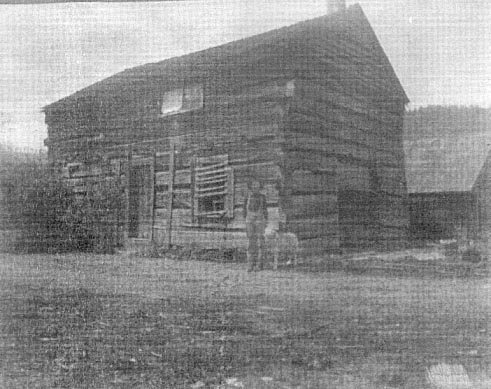
The simple log house that the Riddle family built in Douglas County, Oregon in
1852, soon after arriving on the Oregon Trail
(Courtesy Southern Oregon Historical Society)

Then at Black Rock Desert, in northwest Nevada, they turned off the California Trail and onto the Applegate Trail - which would take them north into Oregon.  From there, the route was especially treacherous as they traveled in many miles of desert, with no water.  There, they were able to witness the evidence of previous wagon train crossings in which animals died or they had to abandon items. "We were seldom out of the sight of the carcasses of dead cattle" and "all along the road were abandoned wagons, household goods of every description.  Here would be a cook stove, further on a plow, then the remains of a feather bed."  The following year, the wagon train containing the Merriman and Constant families (described below) claimed to have found an abandoned wagon in this area belonging to a Mr. Riddle.  The Riddle family did describe abandoning their carriage - but that was along the Platte River (in Nebraska or Wyoming) - and not in Nevada. 
When the party was still in Nevada, they uncovered two abandoned fifty gallon barrels - one filled with whiskey and the other with brandy.  The emigrants made the decision to take the alcohol with them.  The train then arrived in northern California and made its way north.  At Tule Lake, they had a nonviolent confrontation with the local Indians (the following year, a wagon train was massacred at this very location and it came to be known as "Bloody Point").  From there, they traveled into Oregon and continued to make their way north.  By this time, the family's food supplies were almost gone, but they were fortunate to come across pack trains who sold them some food. 
They arrived at Canyonville, Oregon on September 20, 1851.  Most of the wagon train continued on to northern Oregon, but the Riddles decided to stay there.  They went nearby to the Cow Creek Valley and claimed a 320-acre farm there. They are credited as being the first white settlers of in the Cow Creek Valley. At that time, the Riddle family were among a very small group of white settlers in all of southern Oregon.  Apparently, their nearest neighbor was 8 miles away and there were only 3 other houses in 25 square miles.  Apparently, my great-great-great-grandmother Artinecia (then 20) and her sister Isabella (then 18) were not happy about this.  According to George "This seemed out of the world to my two older sisters and I remember there were tears and wailings that we have left Illinois and endured all of the hardships of the plains to settle down in a place where they would never see anyone and never have any neighbors." 
The small city of Riddle, Oregon (platted by their son John in the 1880s) was named after their family.    
References:
Riddle, George W. Early Days in Oregon. South Umpqua Historical Society, Canyonville, OR, 1993 (written in 1920).

Transcript of interview with Artinecia Merriman, Oregon Journal, Sep. 19, 1915.

Genealogical Material in Oregon Donation Land Claims, Volume III.


1852 - Merriman
William Merriman crossed the Oregon Trail
in 1852, but his wife and son both died during
the journey
(courtesy Douglas County Museum)
In 1852, my great-great-great-grandfather William H. Merriman was a 27-year old carpenter who lived with his wife and two children near Springfield, in central Illinois.  In 1850, William’s brother-in-law Isaac Constant returned to Illinois from a trip he had taken to Oregon.  He began telling his neighbors and relatives about the charms of the Oregon Territory and began inspiring them to move out west.  One family that he convinced to pack up and move was that of his brother-in-law, William Merriman.

William and his family - which included his wife Mary and their two small children, Auletta (3) and Joseph (infant) - decided to make the trip.  Also coming was Isaac Constant, his wife Lucinda Merriman Constant, and their 6 children: Lavinia, Thomas, Elizabeth, Julia, Margery and Alice.  All of the other Merriman family relatives (including 5 siblings of William and Lucinda and many nieces, nephews and cousins) decided to remain in Illinois.
Luckily, we have many details of this particular Oregon Trail journey.  Many years later (during the 1890s), the details of the crossing were written down by Thomas Robinson who interviewed his mother Lavinia Constant Robinson (William Merriman's niece, who was 18 at the time of the journey) about her experiences on the trail.  Lavinia's story, A Brief Review of the Life of Isaac Constant, can be read online.

The family left Springfield on March 2, 1852.  From there, they traveled by wagon to St. Louis, Missouri, where they spent a few days with a relative who lived there.  They then boarded a boat and traveled on the Missouri River from St. Louis to Independence (near what is now Kansas City).  The group then spent a few weeks in Independence, preparing for the wagon train.  During this time, Isaac Constant was elected Captain of the wagon train.  The family left Independence in the early days of April 1852, and the train was off!


Sadly, William Merriman’s wife Mary was very sick with an unknown illness when the journey began.  She died at the first stop after leaving Independence, somewhere in what is now eastern Kansas.  They had to send back to Independence for a casket to bury her in.  She is probably buried somewhere by the trail’s side.  The situation must have been especially tragic for William.  His wife was now dead and he had two very young children.  His baby, Joseph, was so young that he was still nursing at the time of his mother’s death.  To keep the baby alive, William fed him milk from one of the cows in the train. 


The wagon train continued on the Oregon Trail; going through what is now Kansas, Nebraska, Wyoming and into Idaho.  Near Fort Hall, Idaho (near what is now Pocatello), the train split in two; one trail going west towards northern Oregon and one trail going southwest towards California and southern Oregon.  The Merrimans and Constants continued on the southern trail (also known as the California Trail).  From there, they traveled through Nevada and then took the Applegate Trail into northern California.  When the family stopped at Goose Lake (border between Oregon and California); the cow that was providing milk for William’s baby Joseph had eaten some wild parsnips (which are poisonous).  After drinking the milk, the baby sadly went into convulsions and died.  During the whole trip, the only deaths in their wagon train were William’s wife and son.  At some point during the trip, Indians attacked their train and stole two of their mules and ate them. 

The train then entered Oregon and arrived at its destination in what is now Jacksonville, Oregon on September 21, 1852.  William did not remain in Jacksonville for long.  He left his 3-year old daughter in the care of his sister Lucinda and proceeded about 80 miles north to what became Douglas County, Oregon.  There, he began to court a young widow named Artinecia Chapman (they had known each other when they lived in Illinois).   She had migrated from Illinois with her infant son, parents and siblings the previous year (see above).  They married in February 1853 and settled briefly near her parents in Douglas County, Oregon before moving permanently in Jackson County, Oregon in 1857. They had a large family - 15 children in addition to their 2 children from previous marriages.  Merriman Road between Medford and Central Point is named for their family.


Isaac Constant and his family settled on a land claim in the valley northeast of Jacksonville.  Eventually the town (and later city) of Central Point sprang up around their home - and they are considered by many to have been the founders of Central Point.

References:

"A Brief Review of the Life of Isaac Constant." Written by Thomas M. Robinson from an interview with his mother, Lavinia Constant Robinson, c. 1890s.


Obituary of Julia Owen, Central Point American, Jan. 9, 1936, Pg. 1
Genealogical Material in Oregon Donation Land Claims, Volume III.
1852 - Plymale
Sarah Plymale was 12 years old when she crossed
the Oregon Trail with her family.  Later, she and her
sisters were among the only eligible females in
Jacksonville, Oregon (there mostly being gold miners)
(courtesy Southern Oregon Historical Society)
In the late 1840s, my great-great-great-grandparents Gabriel Plymale and Polly Hatfield Plymale lived with their family near Galesburg, in northwest Illinois.  They were farmers and also involved in the lumber trade; requiring biannual trips to Chicago, Illinois.  In 1848 or 1849, Gabriel’s brother James Plymale left his home and went to California to mine for gold.  James was successful in locating gold in California; but was attacked and robbed on his way back east – resulting in the loss of all of his gold and apparently one of his arms.  Despite this, his experience had apparently given his brother Gabriel the desire for adventure and “gold fever”.  Eventually, Gabriel and Polly made the decision to abandon their life in Illinois and try their luck mining for gold on the west coast.  When gold was discovered in what is now Jacksonville in southern Oregon in late 1851, they quickly made the decision to move there.
The Plymales left their Illinois home in the spring of 1852.  Their party included 15 family members; 47-year old Gabriel and 48-year old Polly; their 9 unmarried children: Anderville  (21), Francis (19), Elizabeth (17), William (my great-great-grandfather - 15), Sebastian (13), Sarah (11), Narrissa (10), Mary (8), and Emma (4).  Also coming in the train was their eldest daughter Minerva  (22), her husband Robert Armstrong (25) and their two children: Marcus (3) and Mary (1). 
My great-great-great-grandmother Polly Plymale brought this
"ginger jar" with the family during
their trip over the Oregon
Trail in 1852.  She gave it as a wedding gift in 1867

(courtesy Southern Oregon Historical Society)
We know little about this particular Oregon Trail migration – other than that they came by the California and Applegate Trails (which would have taken them through Illinois, Missouri, Kansas, Nebraska, Wyoming, Idaho, Nevada, northern California and finally into Oregon).  At one point in their journey, there was some kind of commotion which caused the oxen in the train to stampede.  The Plymales’ 1-year old granddaughter Mary Armstrong fell from the moving wagon but was saved from death by her mother who grabbed her leg and pulled her to safety.
Eventually, in the fall of 1852, they had reached northern California.  The train stopped at Goose Lake (on the border between California and Oregon), and Gabriel and his oldest son Anderville made the fatal mistake of drinking from the lake.  At this point, they were out of supplies and then made a slight detour for Yreka, California.  They then continued on their journey and arrived at their destination (now Jacksonville, Oregon) on October 13 or 14, 1852.  The family settled briefly in makeshift housing in the mining town.  Although they had reached their destination, it was not an easy time for them.  Gabriel and Anderville had both contracted typhoid fever from drinking contaminated water at Goose Lake – and they were soon on their death beds.  Gabriel died first, on November 14 (just one month after arriving) and his son Anderville died one month later, on December 22. 
The Plymales were now in a difficult situation.  Polly Plymale had uprooted her life and her family to follow her husband’s dreams of mining for gold.  Now her husband and eldest son were dead, she was in a strange place and had no way to support her family of 9 children.   They remained in their camp in Jacksonville throughout the winter of 1852-1853.  During this time, she apparently decided to make the most of her situation and remain in the area to do what she knew best: farm.  In the spring of 1853, the family went into the valley east of Jacksonville and claimed a farm of 320 acres.  The family built a house and soon cultivated a successful ranch on their land claim. 
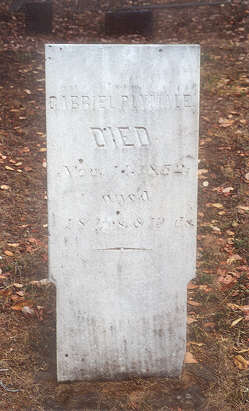
Gabriel Plymale's headstone in the historic
Jacksonville Cemetery - the oldest one in the
cemetery.  He died exactly one month after
arriving on the Oregon Trail from Illinois, leaving his
widow alone in a strange place to care for their children
The Plymale Cottage in Jacksonville (built in 1868) is named after the family of Polly’s son William Plymale, who lived in the house with his family between 1890 and 1904. 
Many years after their emigration, Polly's son William Plymale wrote an article called "The Unknown" which described an incident in an 1852 Oregon Trail migration.  Although he doesn't explicitly describe being on the train, it was most likely the wagon train that the Plymales traveled in (he was then 15 years old).  Most of the article described an incident where a wagon train traveling ahead of them was ambushed and attacked by Indians near Tule Lake, in northern California.  When they arrived at the location a day or two later, it was a scene of bloody carnage and they had nothing to do but bury the dead and proceed on their way.  They were escorted by a military guard who had come too late to save the earlier train from attack.

References:

Plymale, John F. The Plymale Family in America. Commercial Printing & Lithographic Co., Inc., Huntington, WV, 1967.

Genealogical Material in Oregon Donation Land Claims, Vol. III. 1962
"History of the Zigler-Plymale Families."  Written in 1964 by Claud A. Zigler (grandson of Gabriel and Polly Plymale).

Tombstone inscriptions, Jacksonville Cemetery, Jacksonville, Oregon
Other:

1845 - Martin and Knighton
As described above, In 1844 William Martin returned to Missouri from an expedition trip to Oregon and California and began trying to convince his family and relatives to move out west.  He was able to convince his brother Hardin Martin and his sister Elizabeth Knighton to move out west first with their families.  Hardin and Elizabeth were able to get everything in order to leave in 1845.  

The wagon train they traveled in included 293 people in 66 different wagons.  It started from St. Joseph, Missouri sometime in April or May 1845.  Hardin Martin was the lieutenant of the wagon train company.  In the party included Hardin Martin, his wife Eveline Martin, his nephew William Martin, sister Elizabeth Knighton; her husband Henry Knighton and their daughters Josephine and Lascelle Knighton.  

The family safely arrived in northern Oregon in the fall of 1845.  Elizabeth Knighton and her family remained in Oregon City, Oregon.  Hardin Martin though moved to rural Yamhill County, Oregon.  The following year, a wagon train arrived from Missouri which included their parents, two of their brothers, and various other relatives. 
1848 - Brodie
In 1848, Lodowick Brodie was a 48-year old farmer who lived with his family in Missouri.  He had a wife and at least 7 children at home.  (Lodowick Brodie was the brother of my great-great-great-great-grandfather David Brodie of Clarksville, Tennessee).  When gold was discovered in California in 1848, he decided to leave his family and go west in search of gold.  Apparently, "circumstances of embarrassing nature" compelled to him to leave his family (perhaps he had very bad financial problems).  The details of his journey to California are unknown.  Sometime in 1850 though, he decided to return east to his family.  Instead of going overland, he decided to make the trip by sea.  He left by ship from San Francisco and then traveled south to the Isthmus of Panama, and then by ship north through the Caribbean and Gulf of Mexico.  The destination was probably New Orleans, and then up the Mississippi River back home.  Unfortunately, he never made it home.  Lodowick died of illness in November 1850, while at sea.  Conflicting sources suggest he died either on the Pacific Ocean and or in the Gulf of Mexico.  He was buried at sea.
1871 - Murray
In 1871, my great-great-great-grandparents James Murray and Flora Bartlow Murray lived with their children on a farm in northern Illinois.  For unknown reasons, they decided to move to Oregon.  They were probably following the example of some relatives who had moved to Oregon previously.  The Murrays did not technically travel on the Oregon Trail.  Since their move was so (relatively) late, they were able to take advantage of the Transcontinental Railroad that had been completed in 1869.  The family left their home in northern Illinois and made their way west.  They made the journey by train from Council Bluffs, Iowa to San Francisco, California.  That span of the journey would have taken about 7 days (much quicker than the 5 or 6 months it would have taken in a wagon train).

In San Francisco, the Murrays boarded a ship to take them to Portland, Oregon.  During the sea crossing, there was such a violent storm off the Oregon Coast that their boat nearly sank.  Apparently, it was so traumatic that during the storm "some were just shouting, some were cursing and some was praying and some was singing."  The storm subsided though and the family made it safely to Portland.  From Portland, they acquired a wagon and team of oxen and made the journey by land south from Portland to what is now Medford, in southern Oregon.  There, they purchased a farm where James and Flora remained until their deaths.  The location of their original farmhouse is now the site of a Walmart. 

Sunday, January 26, 2014

My family and their cars

This post is a short gallery of my ancestors and their motor vehicles.  Anyone have any additional photos to contribute?

My great-grandmother Vera Merriman and her boyfriend in a car, mid-1910s, southern Oregon

My great-grandfather Odin Wadleigh and his car, apparently changing a tire.  Probably early 1920s, Indiana

My great-grandmother Vera Merriman and her car, early 1920s, southern Oregon.  Engraving vehicles with the owners initials (V.V.M. for Vera Vivian Merriman) was apparently popular in that time period.

My grandmother Bettye Brown and my great-grandmother Louetha Jones Brown, probably 1925 or 1926 in Arkansas

My grandmother Bettye Brown in front of the family car, early 1930s

My grandmother Bettye Brown and great-grandmother Louetha Jones Brown, mid-1930s (1936 Buick)

My grandfather Ben Plymale with the family car (1949 Buick Super 8) in 1952, Seattle

Wadleighs in their 1953 Ford Crestline convertible in Long Beach, CA, in1953. Left to right: Bettye Brown Wadleigh, Randy Wadleigh, Louise Custer Wadleigh, Mark Wadleigh, Karen Wadleigh

My dad Randy Wadleigh in front of the family car (1959 Chevrolet Impala Station Wagon), circa 1962 on the California coast